


CERCHIARA DI CALABRIA: A Journey Through Myths, Traditions, History, and Nature
How many will choose the province of Cosenza for their summer holidays, or those seeking alternative stays focused on simplicity, well-being, and traditions?
They are awaited — and, of course, warmly welcomed — by the legendary Calabrian hospitality in Cerchiara di Calabria, a charming mountain village nestled in the Pollino National Park,
a territory that is part of the European and Global Geoparks Network under the patronage of UNESCO.

An ideal destination for nature and history lovers, the Pollino National Park, straddling the regions of Basilicata and Calabria, captivates its visitors with breathtaking landscapes and majestic peaks rising over two thousand meters. It offers powerful emotions to those who choose to explore unspoiled places where time seems to have stood still.

Bifurto Abyss
For those who enjoy a touch of adventure, the Bifurto Abyss — also known as the “Wolf’s Pit” — awaits the more experienced explorers. This chasm, located in the heart of the Park, plunges into the depths of the Earth, reaching 683 meters in depth, ranking among the deepest caves on the planet!
It is a vertical cave formed by the relentless action of water, which over time carved its way through the rock, creating a passage deep into the underground.

Sanctuary of the Madonna delle Armi
An ancient legend tells that in 1450, some hunters saw a doe slip into a small cave on Mount Sellaro. When they followed it inside, they discovered two wooden icons depicting the Evangelist Saints.
The hunters brought the icons back to their hometown, but mysteriously, they kept disappearing and reappearing at the same spot in the cave. This phenomenon was seen as a divine sign, and it was decided to build a Sanctuary on that very site.

The Madonna delle Armi has been celebrated every year since 1846, on April 25th, with a mountain procession during which ancient hymns are performed. The feast was established in gratitude for a bountiful harvest granted by the Madonna delle Armi to the townspeople after a period of drought.
It is one of the most evocative and revered Marian sites in the region.
Contrary to what one might initially assume, the title “Madonna delle Armi” does not refer to a military concept. Instead, its meaning may derive from Greek and is linked to the word for “caves,” referring to the distinctive caverns that run through the interior of Mount Sellaro.

Grotta delle Ninfe (Nymphs’ Cave)
For those who love to relax in nature, the perfect place is the Grotta delle Ninfe (Nymphs’ Cave), known since the time of Magna Graecia. From June to September, visitors can enjoy an unforgettable day at this site, for a small fee. According to myth, the cave was once the dwelling of the nymph Calypso.
It is a natural thermal spring that emerges from the rocks of the Pollino National Park, with sulfurous waters that exceed 30°C and therapeutic muds that make the experience truly unique. Thanks to its beneficial properties, the water of Cerchiara is used to treat various ailments, particularly dermatological conditions.

In the heart of nature,” says Alessandra Lauria, Councillor for Thermal Tourism, “wrapped in ancient legends, the Grotta delle Ninfe welcomes you with its healing waters and natural vapors: an oasis of peace where body and soul rediscover balance, health, and wonder.

BREAD THAT DELIGHTS
One of the most beloved local specialties for food lovers and fans of traditional cuisine is the classic bread with a distinctive “hump,” formed during the slow cooling process. Baked in wood-fired ovens, this bread is recognized within the Calabrian agri-food supply chain with the De.Co. (Municipal Designation of Origin) label, as well as the collective geographical trademark Pane di Cerchiara, made with natural sourdough.
You can always enjoy this symbolic food of the town in the various local bakeries, most of which are run by women—perhaps paired with typical products from the traditional cuisine of the Pollino area

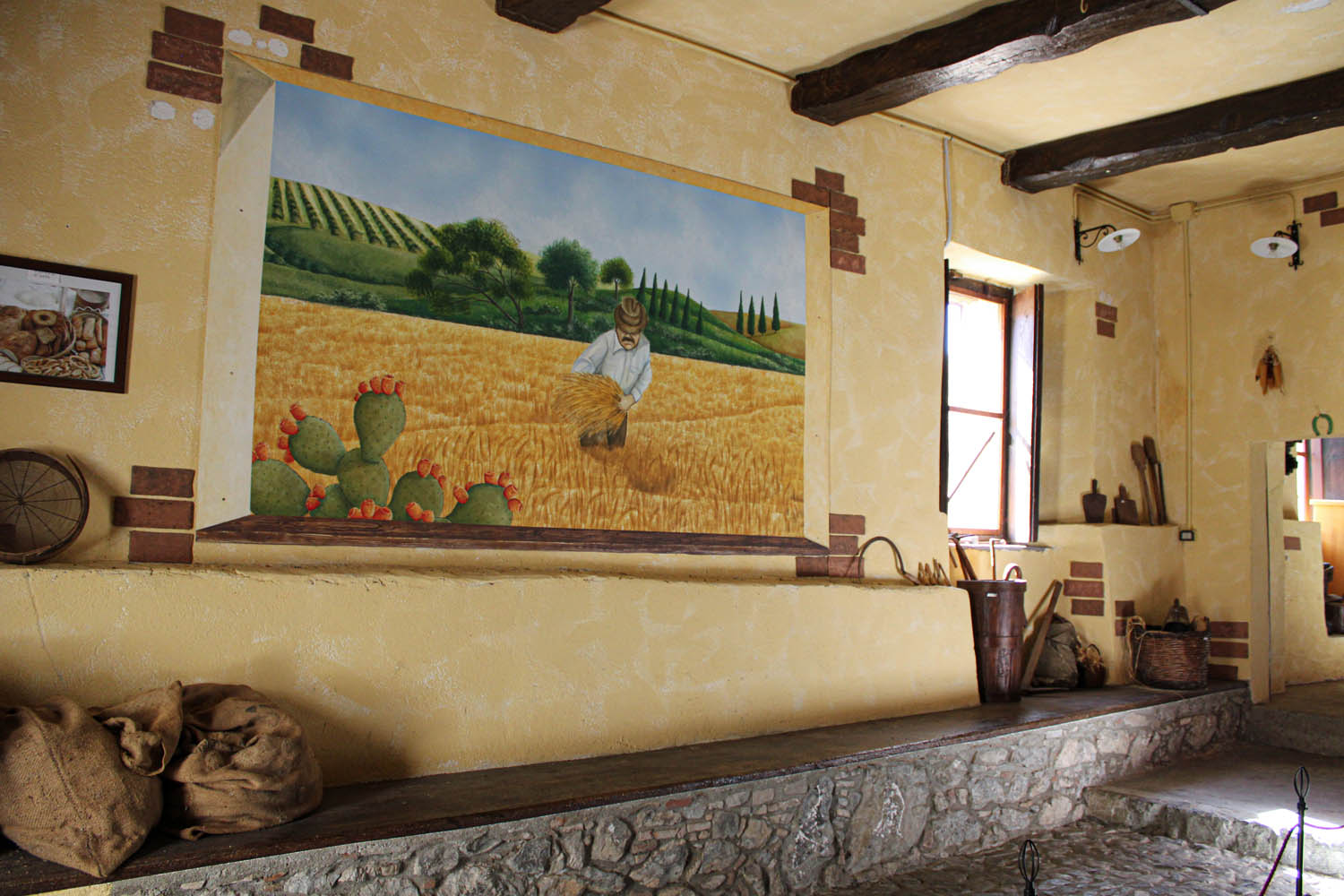
The village, which has witnessed the passage of various civilizations—Byzantines, Lombards, and Normans—hosts the now well-known Museum of Bread and Rural Life. The museum features vintage tools, ancient millstones, photographs, and life-size reproductions of the traditional bread-making process.
Cerchiara di Calabria, with the warm hospitality of its people and its cultural, historical, and culinary excellence, awaits guests for a healthy, enjoyable, and truly unique holiday.

We look forward to welcoming you to Cerchiara di Calabria, one of the most enchanting villages in the Pollino Park,” adds Deputy Mayor Marica Nicoletti. “Here, history, nature, and tradition intertwine—from the historic center nestled on the slopes of Mount Sellaro, to breathtaking views and the authentic flavors of local cuisine.
It’s a place that deserves to be discovered slowly, through walks, history, spirituality, and heartfelt hospitality.

Thanks to engineer Nicola Barone—now President of TIM San Marino and a native son of this land—Cerchiara di Calabria once became the protagonist of a Telecom Italia phone card issued before the arrival of the euro, featuring an image of the Sanctuary of the Madonna delle Armi. Barone also wrote a book about his life, dedicating several pages to his hometown.
NICOLA BARONE: A LIFE AS PRESIDENT. A TRULY ITALIAN STORY.
On Wednesday, July 16 at 6:00 PM, in the heart of the Republic of San Marino, on Piazzale Domus Plebis, I will have the honor and pleasure of hosting an event to present the book “Nicola Barone: A Life as President”, written by Barone himself in collaboration with journalist Santo Strati, editor-in-chief of Calabria Live.
The book offers a portrait of an Italy that renews itself, rolls up its sleeves, and looks to the future. It includes introductions by prominent figures such as Cardinal Ángel Fernández Artime and Bishop Donato Oliverio.

The event will be attended by Don Marco Mazzanti, Director of the Salesians and Rector of the Basilica of San Marino; Luca Beccari, Secretary of State for Foreign Affairs; and H.E. Monsignor Domenico Beneventi, Bishop of San Marino and Montefeltro. The presentation will be accompanied by the Camerata del Titano Orchestra of San Marino.
Nicola Barone, now at the helm of TIM San Marino, was born in Cerchiara, a small Calabrian village where everyone knows each other by name and where the sense of community remains sacred. In his book, he traces—step by step—an exemplary personal and professional journey.
You don’t need big stages to tell a great story.
Sometimes all it takes is a village in the hinterland, a strong family, unwavering faith, and a clear vision.

Many are the successes achieved by Nicola Barone—with a graceful, determined style, marked by listening, competence, and vision—qualities that have taken him far. But be warned: in this book, readers won’t find self-celebration.
Instead, they will discover a truly Italian story—one of those real ones—that reminds us how the most authentic essence of our country lies not only in places, but in people.
In men and women capable of building, day by day, the best face of Italy.
There is the young man leaving the South with dreams in his suitcase.
There is the man who believes in dialogue and cooperation.
There is the professional who combines the rigor of his role with a human touch—never distant, never cold.
Barone graduated from the Polytechnic University of Turin and played a key role in the major transition from analog to digital. But what stands out most in his journey is the consistency with which he has brought strong ethics and deep spirituality into the world of telecommunications and information technology.
In the book, Barone takes us on an autobiographical journey that is, above all, an inner one.
In an era where everything seems to move too fast, he reminds us that true innovation is not only technical—but also human.

The Salesian teachings, the love for his family, and his deep bond with the Sanctuary of Santa Maria delle Armi in Cerchiara—these are the pillars that have supported Nicola Barone throughout his life. A life in which spirituality and technology have never been separate worlds, but intertwined dimensions of a single life project.
Technology has certainly evolved—“I was born analog, today I’m 100% digital,” he writes—but it has never diminished his humanity.
And this, perhaps, is Nicola Barone’s most distinctive trait. He has built information networks, yes—but also networks of trust, listening, and responsibility. He has lived leadership as a form of service, not as power.
He has shown that one can be a true agent of change while remaining faithful to the values received, and above all, he has demonstrated that roots are not a hindrance—but a strength.
We are often led to believe that, in order to succeed, we must “leave our origins behind.”
Stories like this, thankfully, prove the opposite.
It is precisely from the provinces—from those small towns with a church, a square, and a school—that a far-reaching vision can be born.
The spiritual dimension that runs through the entire book is not an ornament, but the very heart of the narrative: Barone has been—and continues to be—what Don Bosco would call a good Christian and an honest citizen.
A man who has managed to unite skill with conscience, technology with faith.

In an age where young people have access to everything except true role models, Nicola Barone represents a credible and concrete example—one of those who don’t impose themselves with words, but earn respect through action.
His is a form of technological humanism, something we urgently need today, because it teaches us that even in the digital world, we can—and must—remain human.
In fact, that’s precisely where our humanity matters most.
Nicola Barone’s story shows us that true modernity doesn’t deny the soul, and it leaves us with a powerful message:
A successful life is one that lights the way for others.
And let’s be honest: there’s something deeply poetic and symbolic about the fact that such a timely message emerges from a tiny Republic like San Marino—the oldest in the world. It reminds us that greatness doesn’t lie in numbers, but in vision and dedication.
The best of Italy is made up of people like Nicola Barone: quiet, determined, and visionary.
People who remind us that you can go far—even from a small Calabrian village.
People who never forget where they started, and never stop looking forward.

Giornalista detentore dal 2015 del Guinness World Records TV e Ambasciatore Borghi più Belli d’Italia.
Leggi in:
 Italiano