


Cingoli. Da balcone delle Marche a Borgo dei Borghi
By Sandra Jacopucci
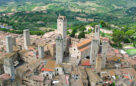
Who was Circe? A sorceress, a goddess, or a witch? And what links Cingoli to this legendary figure? Cingoli, in the province of Macerata, in the spring of 2026 was elected Borgo dei Borghi: a very fortunate town at 630 meters above sea level, stretched across the summit of Monte Circe. Its name derives from the famous sorceress of Greek mythology who, according to legend, during her passage, was so enchanted by this place that she became its ruler. It is even said that the village was founded by her, daughter of Helios, God of the Sun. And it is no surprise that even a sorceress was bewitched by such beauty.

But Cingoli is not just legend. Its roots go back to a much more concrete and ancient past: already inhabited in Picene times, it later became a Roman municipium under the name of Cingulum. It is said that its walls were even reinforced by Titus Labienus, lieutenant of Julius Caesar. In the Middle Ages it became a free commune, contested and lived in, until it was permanently incorporated into the Papal States. Even today, walking through its alleys and walls, one can feel this layering of stories, as if every stone had something to tell.

Thanks to its privileged position, Cingoli is also known as the “Balcone delle Marche”. From the medieval castle walls, one can enjoy a view of much of the Marche region and, on the clearest days, beyond the Adriatic Sea, it is even possible to glimpse the coasts and mountains of Dalmatia, in Croatia. “Non è ancora notte a Cingoli” is the iconic expression used by the people of Cingoli to describe this hill kissed by the sun until its very last ray of the day.

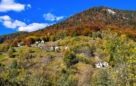
The village is immersed in one of the areas with the richest and most fascinating flora of the Marche landscape. Breathing healthy air, one can regenerate through evocative horseback rides, trekking, and e-bike excursions. Five magnificent routes have been mapped, also with QR codes, immersed in the greenery of the Macchia delle Tassinete, which preserves a millenary yew tree with a trunk five meters in circumference, the second largest in the Marche region. The yew is also known as the “Tree of Death”: its bark, berries, and leaves contain a toxic substance, taxine. Since ancient times, its wood has been used for making spears, arrows, and bows, so much so that the oldest wooden human artifact is made of yew.

At the foot of the village, framed by hills that seem painted, lies the Lago di Cingoli, also known as “Lago di Castreccioni,” named after the dam that created it in the 1980s by blocking the course of the Musone River. Located within the Provincial Wildlife Protection Oasis, it is the largest artificial basin in the Marche region and central Italy.
Today it is a very popular destination, both for relaxing freely or in equipped areas and beach establishments where one can enjoy typical cuisine (which we will discuss in detail in another article), and for numerous outdoor activities: from boat rentals to water sports such as kayaking, canoeing, and sailing.

Improperly called the “sea of the people of Cingoli,” because it has always been a summer reference point for locals, it has become over the years an increasingly sought-after destination also for tourists and travelers from all over the world.

Its tributary, the Musone River, about 76 km long, originates inland and flows into the Adriatic. Along its course it offers the evocative “cascatelle”, among the most photographed views of the Cingoli area.

The lake is crossed by the Cingoli viaduct, an important infrastructure that connects the village to the main road network, facilitating connections with the Musone valley, Apiro, Staffolo, and access to the highway toward Jesi and the coast.

In Cingoli there is also a unique place in the world: the Museo del Sidecar, in Via Valcarecce, which houses a collection of over one hundred sidecars, from the earliest models of the early twentieth century to the most recent ones. Among the most curious pieces are some world records: the longest, the smallest, the widest, and the largest sidecar. A truly surprising stop.
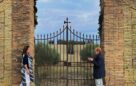
Just outside Cingoli, there is an image that remains etched in visitors’ memory: the Eremo di Santa Sperandia, a small rock church set into the stone, inspired by a young woman from Gubbio.

According to tradition, Sperandia was born in the 12th century and initially lived a simple and ordinary life, but very soon showed a strong inclination toward spirituality and contemplation. She chose this place immersed in the silence of the woods and a life of penance and prayer, distancing herself from her family context to devote herself completely to God.

The hermit lived in poverty and solitude in a small cave adjacent to the church, which can still be visited today. Only later, after her death, her reputation for holiness and accounts of miracles led to her recognition as a saint. The interior of the church and its architecture embody her desire for essentials and authenticity. Who wouldn’t want to visit such a place at least once in a lifetime?
But the most important church in Cingoli and one of its main historical and artistic symbols is the Collegiata di Sant’Esuperanzio, the patron saint of the city.

It was built between the 13th and 14th centuries in Romanesque-Gothic style, with a stone façade, simple yet elegant. The interior has three naves and preserves works of great value: a famous polyptych by Antonio Vivarini, frescoes and medieval decorations, and the crypt, linked to the cult of Sant’Esuperanzio. It is a place very dear to the people of Cingoli, both from a religious and identity perspective, and represents the spiritual heart of the village.

The Chiesa di San Filippo Neri, not to be confused with the Cathedral of Cingoli (Co-Cathedral of Santa Maria Assunta), reveals a different character, fully Baroque compared to the Eremo di Santa Sperandia and the Collegiata di Sant’Esuperanzio, both characterized by strong architectural simplicity and a sober Romanesque style. A church dedicated to Santa Maria already existed on the site in the 13th century, which in the seventeenth century passed to the Filippini Fathers and was completely rebuilt. Thus, although the exterior retains medieval traces and a discreet façade, the interior bursts into Baroque splendor, leaving visitors astonished by the unexpected contrast.

Here the space becomes more articulated and welcoming, designed for preaching and the participation of the faithful according to the spirit of the Oratory. The interior shows greater scenographic care, with harmonious proportions, more elaborate altars, and a collected but less austere atmosphere. The result is a place that, compared to the severity of the other two buildings, expresses a more communicative and “pastoral” religiosity, typical of the modern age.
The celebrated artistic masterpiece of the Italian Renaissance, the Madonna del Rosario by Lorenzo Lotto, is instead housed in the Pinacoteca Civica Donatello Stefanucci of Cingoli, located inside the Palazzo Comunale, in the Sala degli Stemmi.

It is one of the most important museums in the Marche region and preserves other valuable works by great artists of the past, from the Middle Ages to contemporary works of twentieth-century artists such as Donatello Stefanucci, from whom it takes its name, considered the “painter of the soul of Cingoli.”

The Biblioteca Comunale Ascariana is another excellence of the village and, at this point, one wonders how such small places can contain so many treasures. It is a very rich historic library, with thousands of volumes, including ancient texts and manuscripts. It is an important reference point for the town and also preserves documents related to local history.

“Many foreign tourists, fascinated by these magical places, have decided to move here and open important hospitality businesses,” explains the Tourism Councillor of the Municipality of Cingoli and coordinator of the Borghi più Belli delle Marche, Cristiana Nardi. “Together with the National President of the Borghi Più Belli d’Italia, Fiorello Primi, we look ahead, carrying with us what makes Cingoli special: authenticity and a cultural, natural, and food-and-wine heritage that deserves to be experienced and enhanced.”
We leave the conclusion to the Mayor of Cingoli, Michele Vittori: “The kind of tourism we would like is slow and attentive, aimed at visiting and understanding places.” He also defined the victory of the Borgo dei Borghi title as “a historic moment for the entire community of Cingoli. It is a great dream come true.”
Eventi a Cingoli
Cingoli Letture di Primavera 2026 –
9 Fossi – Trofeo Città di Cingoli – April 26, 2026
Concorso “Gli Anni Verdi” – Accademia Labiena
Trofeo del Balcone – A.S.D. Bocciofila Cingoli – January
Festa di S. Esuperanzio – January 24, 2026
Bande Musicali in Concerto – September
Liscio sotto le Stelle 2025 – summer
Cingoli in Bici 2025 – June
Olimpiabili – May
Fiera di Primavera Cingoli – May
Cingulum – L’Olio del Papa – April
Thanks to the Municipality of Cingoli for the photos
Texts Sandra Jacopucci


Giornalista detentore dal 2015 del Guinness World Records TV e Ambasciatore Borghi più Belli d’Italia.
Leggi in:
 Italiano