


Verucchio. The legend of Blessed Gregorio Celli and the lost fresco
by Sandra Jacopucci
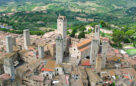
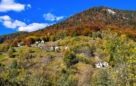
From up here, on clear days, the view stretches from the Apennines to the Adriatic coast, with San Marino emerging on the horizon like a fortress straight out of a medieval dream. Perched on a rocky outcrop overlooking the Valmarecchia, nestled in a sea of greenery, just a few kilometres from Rimini, Verucchio (RN) – part of the prestigious circuit of Italy’s Most Beautiful Villages and holder of the Italian Touring Club’s Orange Flag – has its roots in a distant past: it was an important centre of the Villanovan civilisation, which flourished between the 9th and 7th centuries BC, as evidenced by countless artefacts housed in the Civic Archaeological Museum, located in the former Augustinian convent.

It was here that Malatesta da Verucchio, known as ‘the Centenarian’ or ‘Mastin Vecchio’, was born, and it is no coincidence that even Dante, in the ‘Inferno’ of his ‘Divine Comedy’, referred to him by that fearsome epithet. In the Middle Ages, the village became famous for an illustrious name: the Malatestas, one of the most powerful families in Italy at the time. The Malatesta Fortress, which dominates the village from above and was first built in the 12th century, was expanded several times: from its terraces, one can understand why the Malatestas chose this very spot as a vantage point over the entire valley. Then there are the stone-paved alleys, the medieval gateways, Piazza Malatesta with its 18th-century palaces, and the Collegiate Church of San Martino. But we will tell you all about this and much more in the coming days.
First, however, a story in particular that the people of Verucchio have held dear for almost seven hundred years.
The White Mule and Blessed Gregorio Celli
The church of St Augustine — a 14th-century building which, with its Baroque stucco work and paintings, remains a treasure trove of art from the 17th and 18th centuries — preserves the memory of an extraordinary man: Blessed Gregorio Celli. Born in Verucchio around 1225, Gregorio embraced the hermitic life of the Augustinian Order and withdrew to live in solitude in the mountains of the Rieti area, in Lazio.
Ottavio Celli, the expert Curator of the Municipal Art Gallery, tells us that he lived — according to tradition — to the incredible age of 118, dying on 11 May 1343 at Monte Carnerio, near Rieti, far from his native land. But before he died, Gregorio left a specific wish, almost a spiritual testamentary provision: he wanted to return to Verucchio. He wanted to be buried in his homeland, in the church of his Order.

And this is where the legend begins. According to popular tradition, the Blessed One’s body was loaded onto an untamed white mule. The coffin was tied to the animal’s back, and it was set free. No one guided it. No one showed it the way. Yet it travelled the long journey from Rieti to the hills of the Valmarecchia, passing through villages and towns, climbing up the valleys, crossing the mountain passes as if it knew where to go. And in every village it passed through, the bells rang of their own accord, without anyone touching them, as if the heavens themselves were announcing the passing of a saint. The mule arrived in Verucchio. It stopped in front of the door of the church of Sant’Agostino and there, with an instinctive awareness that it had fulfilled its sacred task, it died instantly. Gregorio had returned home.

The frescoes that speak
To recap: Gregorio Celli was born in Verucchio in 1225; he was a friar of the Order of Saint Augustine who, after a period in the community, withdrew to live as a hermit in the mountains near Rieti, where he died in 1343. The veneration of Gregorio Celli in Verucchio has never ceased over the centuries, sustained by popular devotion.
Official beatification did not come until 1769 — almost five hundred years after his death — but to the people of Verucchio he was already a saint. All this was thanks to the decisive support of Pope Clement XIV, who had a personal connection with Verucchio: as a child, he had been nursed by a wet nurse from the village. It is said that one day, whilst he was in danger of choking, the woman turned in prayer to the Blessed Celli — and the future pontiff was saved.
His body rests in the Church of the Fathers of St Augustine in Verucchio. In the past, his holy remains were displayed for public veneration by opening the stone sarcophagus: his skull was placed on the altar on his feast day, which was celebrated every year on the last Sunday in May, and then carried in procession. But this tradition has now been forgotten.

In the now-deconsecrated Augustinian church, a marble sarcophagus—or reliquary—is still visible, along with a partially preserved fresco bearing the Latin inscription ‘Corpus Beati Gregorii Verucule… Translatu die 24 April Ani MDCXII’ — the transfer of the Blessed One’s body, which took place on 24 April 1612. On the interior archway, other fragments complete the devotional cycle: two holy nuns in Augustinian habits holding a book, a tondo depicting a soul supported by angels ascending to glory, and two friars with a crucifix — images that, centred on the figure of the Blessed, create a world of contemplation and lived faith. You can find the details in the gallery at the bottom of the page.
Looking closely at this photo, in addition to the fragments of the fresco, one can make out the trace of a sketch barely sketched in red on the concrete background of the niche, almost invisible. A detail I only noticed whilst reviewing the photos. It is a philological reconstruction of what has been lost and is impossible to reconstruct as there are no photographs of the complete original. It is the result of scholars’ reasoning based partly on objective elements such as residual colour, the position of the niche, or similar images of hermit saints from the same period, and partly on hypotheses. An unfinished work that allows us to avoid a ‘historical forgery’, which would certainly be more realistic but not authentic.
We like to think that even if not everything survives intact, what remains can be reinterpreted, reassembled and given a new voice.
Next to it, in the left apse, stands the large Baroque altar with the painting by Giovanni Maria Morandi (1622–1717), set within an imposing gilded frame carved by Bartolomeo Silvestro da Verucchio in 1673: here, Blessed Gregory is depicted in prayer, surrounded by angels, in the harsh and solitary landscape of the hermit.

The scagliola altar frontal: faux luxury, genuine art
In front of the high altar stands a large scagliola altar frontal, with a deep black background and decorations featuring scrolls, volutes and flowers in shades of white, pink and blue, with a medallion depicting an Augustinian saint at its centre.
Scagliola is an art form unique to the Emilia-Romagna region: originating in Carpi, in the province of Modena, in the early 17th century, it spread rapidly throughout the region thanks to the movements of skilled craftsmen. The commissions were almost exclusively religious, and the requests were specifically for altar frontals.
The principle was as simple as it was ingenious: altar frontals made of coloured plaster scagliola emerged during the Baroque period as an imitation of the more expensive ones made of marble and imported stone, created for the great churches of Italian cities. They also allowed churches in smaller villages to have a sumptuous altar, worthy of the devotion of the faithful.

Another fun fact
In 2008, during excavations of the Villanovan necropolis, the remains of two horses dating back almost three thousand years were also discovered. These were sacrificial animals that probably belonged to the warrior aristocracy. A resin cast was made of the bones, which were then reassembled inside the church, where they can still be seen in a section of the floor.

The Church of St Augustine today
Today, the church has been converted into a classroom. Yet something sacred still lingers in the air. One need only look at this scene, where students study beneath the soaring coffered ceilings and Baroque stucco work, seated just a few metres from the tomb of the Blessed, to realise that certain places continue to educate even when their purpose changes. An example of the virtuous reuse of the Augustinian convent, which was suppressed during the Napoleonic era and remained in a state of neglect for a long time. The students studying Villanovan civilisation within those walls receive a double lesson: in history and in beauty.

We would like to thank the following for the photos and their cooperation:
The Municipality of Verucchio
Ottavio Celli – Art gallery of Verucchio
Text and photos – Sandra Jacopucci


Giornalista detentore dal 2015 del Guinness World Records TV e Ambasciatore Borghi più Belli d’Italia.
Leggi in:
 Italiano