


THE BEES OF MONTECCHIO. SAN MARINO
by Sandra Jacopucci
May 20 World Bee Day
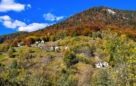
I tiptoed inside. The atmosphere changes the moment you step onto the trail in the Montecchio Nature Park. Just below the silhouette of Mount Titano lies a place cherished like a precious memory: the Republic of San Marino’s Bee Biopark. It feels more like a sanctuary for bees, given the care with which it was created, than an educational trail. Here, the buzzing of the insects blends with the scent of the forest and the soft rustling of leaves stirred by the wind. It stands as a silent guardian of something we risk losing without even realizing it.

Where it is located
The Bioparco winds along the road leading down to Fonte dell’Ovo, in a 3,500-square-meter green space crisscrossed by nature trails and frequented mainly by families, school groups, hikers, and nature lovers like me. Not far away are the Casa Fabrica, home to the Museum of Rural Life; the Casa Micologica, headquarters of the association of the same name—on June 6, the square in front of it will be named after its founder, Marino Cardinali; and the enclosures housing peacocks, various species of poultry, and fallow deer, which have long been part of the park’s most evocative imagery.
The territory of San Marino is home to miles and miles of natural parks, protected wooded areas, hunting and fishing reserves, and gardens featuring Mediterranean flora and typical Apennine fauna. In this small state, respect for nature is a value as ancient as its independence.

The Bioparco suddenly comes into view along a stretch where the woods open up slightly. The biodiversity of the flora and the silence that envelops it create a perfect ecosystem for this open-air workshop/museum that you explore at a leisurely pace. The Bioparco Apistico project was conceived in 2021 and officially inaugurated in 2023, during a period when the term “biodiversity” was beginning to move beyond specialized circles and enter everyday language. But behind that inauguration lay an idea that had been maturing for some time within the San Marino Beekeepers’ Cooperative: to create a place dedicated to the protection of Apis mellifera ligustica, a native Italian honey-producing bee subspecies increasingly threatened by the spread of hybrid bees, pesticides, climate change, and the loss of natural habitats.

The project is taking shape thanks to a collaboration between the San Marino Beekeepers’ Cooperative, the Secretariat of State for Territory and Environment, the Soroptimist Single Club San Marino, the Terra di San Marino Consortium, and the Office for the Management of Agricultural and Environmental Resources (UGRAA). Of the nine areas evaluated, Montecchio was chosen as the most suitable due to its ecological balance, accessibility, and educational value, thanks in part to its proximity to the Fonte dell’Ovo Middle School.

An environmental conservation project
Based on the guidance of Marco Valentini, the cooperative’s beekeeping expert and consultant, San Marino landscape architect Filippo Piva has positioned the microstructures, seating, and signage in harmony with the site’s natural topography, which already possessed biodiversity features. “It’s like acupuncture,” he tells me, “without any alterations, excavations, or changes in the elevation of the existing plateau.” He envisions the biopark more as a bioethical initiative than as a tourist attraction, as a journey back through the history of the interaction between humans and bees.
It begins with contemporary beehives and traces the path back to the oldest forms of beekeeping, when honey was not yet an industrial product but a rare substance, tied to natural cycles and the survival of rural communities.
The journey through different types of beehives is accompanied by illustrative panels created in collaboration by Monica Stolfi, a graphic designer and beekeeper, with texts by Prof. Melissa Marzi, a science teacher at the San Marino High School, in collaboration with Dr. Thomas Bruschi, which sensitively recount the evolution of beekeeping.

The Bee Hotels: Minimalist Natural Architecture
Even before beehives, these structures spark curiosity: Bee Hotels, hotels for bees. These small structures are made of rebar—the kind used in reinforced concrete, which over time takes on the color of tree trunks—and recycled materials such as reeds, wood, and clay, designed to provide shelter for solitary bees and other beneficial insects. The guests of these “hotels” are solitary individuals. They do not produce honey. They have no queen. They do not live in colonies. Yet they are essential. Bee Hotels simulate natural cavities of various sizes for the nesting and overwintering of insects of all sizes. At the Bioparco, some of these shelters were built by students from the San Marino middle school.
It means transforming an object into an experience, and an experience into responsibility.

Next to the Bee Hotels are the woodpiles: piles of organic matter that become a home for decomposers. This is where the foundation of the food chain comes into play: detritivores and microorganisms that transform waste into nourishment. It is the least visible part of the system. And it is the part without which everything else collapses.
The Kenya Top Bar, born from a project by the NGO Oxfam, revives an ancient idea (already present in Greece in the 17th century) and reinterprets it in a contemporary key. A single trapezoidal body, without a honey super, featuring top bars from which the bees freely build their combs. Here, the beekeeper takes a step back. He does not impose a structure: he observes, he accompanies. It is a transitional model, bridging tradition and modernity.
The Dadant-Blatt is the most widespread model in Italy, a direct heir to the insights of Lorenzo Langstroth and the discovery of the “bee space” (approximately 7 mm), which made it possible to inspect the frames without destroying the nest. This is where modern beekeeping was born: modular, productive, and even nomadic. An efficient structure, designed to follow the flowering seasons and optimize honey production.
The Warré hive, known as the “people’s hive,” designed by Abbot Émile Warré, prioritizes simplicity and accessibility. Economical construction, minimal intervention, modest yields. Efficiency isn’t the point, but the possibility: anyone can produce honey for their own family.

The rustic beehive is an archaic type of beehive, a structure made of planks, logs, or masonry, coming in various shapes and sizes. The arrival of the Varroa destructor mite was one of the reasons for its abandonment.
Straw or wicker baskets are easy to build and practical for collecting honey and swarms, waterproofed with clay or dung; the modern Kenya Top Bar hive evolved from them.
Hollow logs are used vertically in Northern Europe, horizontally, and suspended from trees in Africa (Log Hive). Beekeeping originated alongside agriculture, beginning precisely with the collection of hollow logs in the forest.

The Flight Chamber: Observing without disturbing
The Flight Chamber is the most recent installation, also designed by architect Piva. Dating back to 2025, it is an educational beehive where anyone can explore the fascinating world of bees.
By opening the “peep holes,” visitors can see the Dadant-Blatt hive inside, which features transparent walls so that a beehive can be observed up close through the eyes of a beekeeper. But safely: the flight board—the platform positioned in front of the hive’s opening, essential for the bees’ takeoff and landing—is placed at a height that poses no danger to the observer. It is recommended to open two “viewing windows” simultaneously to create the best play of light for exploration.
It is also an exercise in restraint: open, look, close. Do not interfere. Do not disorient. There is respect in this sequence.
Prof. Luciana Mancini of Soroptimist reveals: – A technological device is also in the works to monitor the life and well-being of the bees: a webcam designed to monitor the hive’s condition remotely, equipped with a QR code that allows users to view vital parameters in real time: temperature, sound, humidity, weight, and honey production.

Flower language: an invisible map
In the undergrowth and among the branches, flowers are signals. Coordinates. Invitations that bees can read with a precision that escapes us. Every corolla is a promise: color, shape, scent, and the amount of nectar and pollen. Bees recognize these variations and chart their routes like a dynamic map that changes from day to day, following the blooms. Some flowers communicate via ultraviolet light—a spectrum invisible to the human eye—drawing veritable landing strips leading to the nectar. Others time their opening to the most favorable hours, synchronizing with the pollinators’ activity.

Close-up images of the understory reveal a subtle, layered biodiversity that is often underestimated. It is here that much of the bees’ work takes place. Not in vast, uniform fields, but in the variations, the differences, and the richness of wild species. It is a system that thrives on a density of possibilities. More flower varieties mean more food spread out over time, greater resilience for pollinators, and more stability for the entire ecosystem. Beekeepers know this well: a hive isn’t just monitored. It’s listened to. Bees are observed as social creatures, but also as indicators of a region’s health. Tiny, fragile, sometimes invisible creatures, yet fundamental to major ecological balances. If they disappear, something has already gone awry long before in the landscape.

Myths to debunk, others to reinforce
“I realized that a man, in addition to living for his own personal good, must inevitably contribute to the good of others: if we are to draw a comparison from the animal world, then we must take it from the world of social animals, such as bees.” — Lev Tolstoj
These words, on a sign at the entrance to the Apicultural Biopark, perfectly introduce what science confirms: the bee colony is a model of collective organization in which the good of the individual coincides with that of the community. I asked the president of the San Marino beekeepers, Gessica Lanzi, to clarify some common misconceptions.

Does the queen bee kill the drone?
No. After mating, the male dies a natural death: by losing his genitalia, he inflicts a fatal wound on himself. The queen, whose sole task is reproduction—laying eggs—can live up to five years, while worker bees do not live longer than 40–60 days.
How does the internal hierarchy of the hive work?
Bees take on different roles based on their age, climbing a sort of professional pyramid thanks to the progressive activation of specialized glands. They start as cleaners, the youngest bees, responsible for cleaning the hive. They then become nurse bees, producing royal jelly through their hypopharyngeal and mandibular glands. The third role is that of the builders, who secrete wax from the wax glands located under the abdomen. Next come the guards, capable of producing venom to defend the colony. Finally, the most daring task falls to the foragers, the oldest bees: they leave the hive — which serves as a protective shell for the others — exposing themselves to external dangers to collect pollen and nectar.

Is it really a monarchy? Does the queen rule?
Despite appearances, the beehive is not a monarchy but rather resembles a presidential republic. The beehive is a superorganism in which each bee functions as a cell: in times of need—accidents, fires, floods—the bees step into other roles to fill any gaps. The social structure is solid, but the balance is fragile, and human intervention is justified only in cases of extreme necessity. This is the philosophy of the organic beekeeper, heir to a tradition in which honey production was not yet industrialized: the bees already possess all the tools to defend themselves and regulate their own population.
Are bees dangerous? Is it right to be afraid of them?
Bees are not aggressive animals. They attack only when they perceive a threat to themselves or the hive, and they do so at a high cost: when a honeybee stings, it loses its stinger and, with it, part of its internal organs, surviving only a few hours. Stinging is therefore an extreme act for the bee, not an instinctive one. The fear many people feel in their presence is understandable, but often disproportionate. Just don’t get agitated, don’t blow on them—carbon dioxide makes them nervous—and don’t wear strong perfumes that can be mistaken for alarm pheromones. A bee buzzing around us is almost always exploring, not threatening.
The hornet and the more aggressive Vespa velutina — the Asian hornet — must be distinguished from the honeybee. This invasive species is now one of the main threats to European beehives: unlike the honeybee, it can sting multiple times without dying and tends to attack even without being provoked. Furthermore, the hornet is omnivorous and lands on anything, whereas the honeybee lands only on flowers.

Where does the geometric perfection of the beehive come from?
The hexagon is the shape that allows every surface to be covered without wasting space. In the early stages of construction, the cells appear rounded, but over time the shape settles into a perfect hexagon—a solution that modern mathematics has shown to be optimal for balancing energy efficiency, stability, and honey storage. It is as if nature had selected, over millions of years, the most intelligent shape.
But there is also something poetic about all this. Every single bee works without having a complete view of the hive. Yet together they create a harmonious, orderly architecture. A collective perfection born of cooperation.

The Bioparco Today
The Beekeeping Bioparco is open to the public free of charge and is used for educational activities, school field trips, and initiatives related to environmental sustainability. The San Marino Beekeepers’ Cooperative continues its work to protect the Ligustica honeybee and, every two years, organizes training courses for new beekeepers. Meanwhile, refresher courses on beekeeping techniques are held annually for local beekeepers who have already received training. This approach opens up new career paths and strengthens existing ones in the honey production sector.
“Wildflower honey is different in every village,” adds Gessica Lanzi, “and varies depending on the blooms: there’s spring honey, early summer honey, and late summer honey.” There are also monofloral honeys, such as those from ivy, heather, acacia, and linden. In collaboration with local beekeepers, we also produce honeys from coriander, sunflower, arugula, and alfalfa, obtained by placing the hives in fields cultivated with monofloral crops.

An oasis of soothing tranquility
An interesting feature is that there is no real barrier between the Bioparco and the rest of the nature park. There are not even any filters or precautions in place to protect these tiny creatures. There is no separation between biodiversity and everyday life, between the trails and the families out for a walk, or the children who stop in front of the beehives with a mixture of fear and wonder.
Perhaps this is one of the visit’s most profound lessons: understanding that the future of the environment depends on our ability to develop an authentic, spontaneous, and conscious respect for Nature in all its forms. A tacit pact of trust between humans and the environment, akin to a handshake in a time when one’s word was worth more than a signature on a piece of paper.
Leaving the trail, one is left with the feeling of just how full of life and tireless work the silence of a forest can be.

We would like to thank the following for their collaboration and photos:
Francesca Barbieri – President of the Soroptimist Single Club of San Marino
Gessica Lanzi – President of the San Marino Beekeepers’ Cooperative
Melissa Marzi – Science Teacher at the San Marino Scientific High School
Text by Sandra Jacopucci


Giornalista detentore dal 2015 del Guinness World Records TV e Ambasciatore Borghi più Belli d’Italia.
Leggi in:
 Italiano